Loading...
Searching...
No Matches
log4cxx::net::SocketAppenderSkeleton Class Referenceabstract
Abstract base class that sends spi::LoggingEvent elements to a remote server. More...
#include <socketappenderskeleton.h>
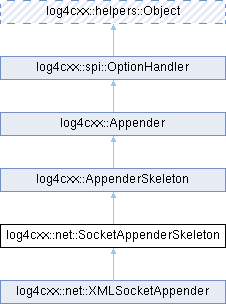
Inheritance diagram for log4cxx::net::SocketAppenderSkeleton:
Public Member Functions | |
| SocketAppenderSkeleton (int defaultPort, int reconnectionDelay) | |
| ~SocketAppenderSkeleton () | |
| SocketAppenderSkeleton (const helpers::InetAddressPtr &address, int port, int reconnectionDelay) | |
Connects to remote server at address and port. | |
| SocketAppenderSkeleton (const LogString &host, int port, int reconnectionDelay) | |
Connects to remote server at host and port. | |
| void | activateOptions () override |
| Activate the options that were previously set with calls to option setters. | |
| void | close () override |
| Release any resources allocated within the appender such as file handles, network connections, etc. | |
| void | setRemoteHost (const LogString &host) |
| The RemoteHost option takes a string value which should be the host name of the server where a Apache Chainsaw or compatible is running. | |
| const LogString & | getRemoteHost () const |
| Returns value of the RemoteHost option. | |
| void | setPort (int port1) |
| The Port option takes a positive integer representing the port where the server is waiting for connections. | |
| int | getPort () const |
| Returns value of the Port option. | |
| void | setLocationInfo (bool locationInfo1) |
| The LocationInfo option takes a boolean value. | |
| bool | getLocationInfo () const |
| Returns value of the LocationInfo option. | |
| void | setReconnectionDelay (int reconnectionDelay1) |
| The ReconnectionDelay option takes a positive integer representing the number of milliseconds to wait between each failed connection attempt to the server. | |
| int | getReconnectionDelay () const |
| Returns value of the ReconnectionDelay option. | |
| void | setSocketSubclass (const LogString &newSubclass) |
Use newSubclass as the helpers::Socket interface instead of the default implementation. | |
| const LogString & | getSocketSubclass () const |
| The class name used for the helpers::Socket interface implemention. | |
| void | setOption (const LogString &option, const LogString &value) override |
Set option to value. | |
| void | activateOptions (helpers::Pool &) |
| Public Member Functions inherited from log4cxx::AppenderSkeleton | |
| AppenderSkeleton () | |
| AppenderSkeleton (const LayoutPtr &layout) | |
| virtual | ~AppenderSkeleton () |
| void | addFilter (const spi::FilterPtr &newFilter) override |
| Add a filter to end of the filter list. | |
| void | clearFilters () override |
| Clear the filters chain. | |
| const spi::ErrorHandlerPtr | getErrorHandler () const |
| Return the currently set spi::ErrorHandler for this Appender. | |
| spi::FilterPtr | getFilter () const override |
| Returns the head Filter. | |
| const spi::FilterPtr | getFirstFilter () const |
| Return the first filter in the filter chain for this Appender. | |
| LayoutPtr | getLayout () const override |
| Returns the layout of this appender. | |
| LogString | getName () const override |
| Returns the name of this Appender. | |
| const LevelPtr | getThreshold () const |
| Returns this appenders threshold level. | |
| bool | isAsSevereAsThreshold (const LevelPtr &level) const |
| Check whether the message level is below the appender's threshold. | |
| void | doAppend (const spi::LoggingEventPtr &event) override |
| Call AppenderSkeleton::doAppendImpl after acquiring a lock that prevents other threads from concurrently executing AppenderSkeleton::doAppendImpl. | |
| void | setErrorHandler (const spi::ErrorHandlerPtr &eh) |
Set the ErrorHandler for this Appender. | |
| void | setLayout (const LayoutPtr &layout1) override |
| Set the layout for this appender. | |
| void | setName (const LogString &name1) override |
| Set the name of this Appender. | |
| void | setThreshold (const LevelPtr &threshold) |
| Set the threshold level. | |
| void | activateOptions (helpers::Pool &) |
| Public Member Functions inherited from log4cxx::Appender | |
| virtual | ~Appender () |
| void | doAppend (const spi::LoggingEventPtr &event, helpers::Pool &pool) |
| virtual bool | requiresLayout () const =0 |
| Configurators call this method to determine if the appender requires a layout. | |
| Public Member Functions inherited from log4cxx::spi::OptionHandler | |
| virtual | ~OptionHandler () |
| void | activateOptions (helpers::Pool &) |
| Public Member Functions inherited from log4cxx::helpers::Object | |
| virtual | ~Object () |
| virtual const helpers::Class & | getClass () const =0 |
| virtual bool | instanceof (const Class &clazz) const =0 |
| virtual const void * | cast (const Class &clazz) const =0 |
Protected Member Functions | |
| SocketAppenderSkeleton (std::unique_ptr< SocketAppenderSkeletonPriv > priv) | |
| virtual int | getDefaultDelay () const =0 |
| virtual int | getDefaultPort () const =0 |
| Protected Member Functions inherited from log4cxx::AppenderSkeleton | |
| AppenderSkeleton (LOG4CXX_PRIVATE_PTR(AppenderSkeletonPrivate) priv) | |
| virtual void | append (const spi::LoggingEventPtr &event)=0 |
Subclasses of AppenderSkeleton must implement this method to perform actual logging. | |
| void | doAppendImpl (const spi::LoggingEventPtr &event) |
Compare event level against the appender threshold and check that event is accepted. | |
| bool | isAccepted (const spi::LoggingEventPtr &event) const |
Does no attached filter deny event or does an attached filter accept event? | |
Detailed Description
Abstract base class that sends spi::LoggingEvent elements to a remote server.
This appender has the following properties:
- The event will be logged with the same time stamp, NDC, location info as if it were logged locally by the client.
- Remote logging uses the TCP protocol, so if the server is reachable, log events will eventually arrive at the server.
- If the remote server is down, the logging requests are simply dropped. However, if and when the server comes back up, then event transmission is resumed transparently. This transparent reconneciton is performed by a connector task which periodically attempts to connect to the server.
- Logging events are automatically buffered by the native TCP implementation. This means that if the link to server is slow but still faster than the rate of (log) event production by the client, the client will not be affected by the slow network connection. However, if the network connection is slower then the rate of event production, then the client can only progress at the network rate. In particular, if the network link to the the server is down, the client will be blocked. On the other hand, if the network link is up, but the server is down, the client will not be blocked when making log requests but the log events will be lost due to server unavailability.
- If the application hosting this appender exits before it is closed, either explicitly or subsequent to destruction, then there might be untransmitted data in the pipe which might be lost.
To avoid lost data, it is usually sufficient to close the appender either explicitly or by calling the LogManager::shutdown method before exiting the application.
A periodic task will connect when the server becomes available. It does this by attempting to open a new connection every reconnectionDelay milliseconds.
The periodic task stops trying whenever a connection is established. It will restart attempting to open a new connection to the server when a previously open connection is droppped.
Constructor & Destructor Documentation
◆ SocketAppenderSkeleton() [1/4]
| log4cxx::net::SocketAppenderSkeleton::SocketAppenderSkeleton | ( | int | defaultPort, |
| int | reconnectionDelay ) |
◆ ~SocketAppenderSkeleton()
| log4cxx::net::SocketAppenderSkeleton::~SocketAppenderSkeleton | ( | ) |
◆ SocketAppenderSkeleton() [2/4]
| log4cxx::net::SocketAppenderSkeleton::SocketAppenderSkeleton | ( | const helpers::InetAddressPtr & | address, |
| int | port, | ||
| int | reconnectionDelay ) |
Connects to remote server at address and port.
◆ SocketAppenderSkeleton() [3/4]
| log4cxx::net::SocketAppenderSkeleton::SocketAppenderSkeleton | ( | const LogString & | host, |
| int | port, | ||
| int | reconnectionDelay ) |
Connects to remote server at host and port.
◆ SocketAppenderSkeleton() [4/4]
|
protected |
Member Function Documentation
◆ activateOptions() [1/2]
|
overridevirtual |
Activate the options that were previously set with calls to option setters.
Connects to the specified RemoteHost and Port.
Reimplemented from log4cxx::AppenderSkeleton.
Reimplemented in log4cxx::net::XMLSocketAppender.
◆ activateOptions() [2/2]
- Deprecated
- This function is deprecated and will be removed in a future version. Call activateOptions() without parameters instead.
- Deprecated
- Use activateOptions() without parameters instead
◆ close()
|
overridevirtual |
Release any resources allocated within the appender such as file handles, network connections, etc.
It is a programming error to append to a closed appender.
Implements log4cxx::Appender.
◆ getDefaultDelay()
|
protectedpure virtual |
Implemented in log4cxx::net::XMLSocketAppender.
◆ getDefaultPort()
|
protectedpure virtual |
Implemented in log4cxx::net::XMLSocketAppender.
◆ getLocationInfo()
| bool log4cxx::net::SocketAppenderSkeleton::getLocationInfo | ( | ) | const |
Returns value of the LocationInfo option.
◆ getPort()
| int log4cxx::net::SocketAppenderSkeleton::getPort | ( | ) | const |
Returns value of the Port option.
◆ getReconnectionDelay()
| int log4cxx::net::SocketAppenderSkeleton::getReconnectionDelay | ( | ) | const |
Returns value of the ReconnectionDelay option.
◆ getRemoteHost()
| const LogString & log4cxx::net::SocketAppenderSkeleton::getRemoteHost | ( | ) | const |
Returns value of the RemoteHost option.
◆ getSocketSubclass()
| const LogString & log4cxx::net::SocketAppenderSkeleton::getSocketSubclass | ( | ) | const |
The class name used for the helpers::Socket interface implemention.
◆ setLocationInfo()
| void log4cxx::net::SocketAppenderSkeleton::setLocationInfo | ( | bool | locationInfo1 | ) |
The LocationInfo option takes a boolean value.
If true, the information sent to the remote host will include location information. By default no location information is sent to the server.
◆ setOption()
|
overridevirtual |
Set option to value.
| Supported options | Supported values | Default value |
|---|---|---|
| RemoteHost | (1) | - |
| Port | {int} | (2) |
| LocationInfo | True,False | False |
| SocketSubclass | (3) | APRSocket |
(2) Provided by the derived class.
(3) A registered class derived from helpers::Socket.
- See also
- AppenderSkeleton::setOption()
Reimplemented from log4cxx::AppenderSkeleton.
◆ setPort()
| void log4cxx::net::SocketAppenderSkeleton::setPort | ( | int | port1 | ) |
The Port option takes a positive integer representing the port where the server is waiting for connections.
◆ setReconnectionDelay()
| void log4cxx::net::SocketAppenderSkeleton::setReconnectionDelay | ( | int | reconnectionDelay1 | ) |
The ReconnectionDelay option takes a positive integer representing the number of milliseconds to wait between each failed connection attempt to the server.
The default value of this option is 30000 which corresponds to 30 seconds.
Setting this option to zero turns off reconnection capability.
◆ setRemoteHost()
| void log4cxx::net::SocketAppenderSkeleton::setRemoteHost | ( | const LogString & | host | ) |
The RemoteHost option takes a string value which should be the host name of the server where a Apache Chainsaw or compatible is running.
◆ setSocketSubclass()
| void log4cxx::net::SocketAppenderSkeleton::setSocketSubclass | ( | const LogString & | newSubclass | ) |
Use newSubclass as the helpers::Socket interface instead of the default implementation.
The documentation for this class was generated from the following file:
